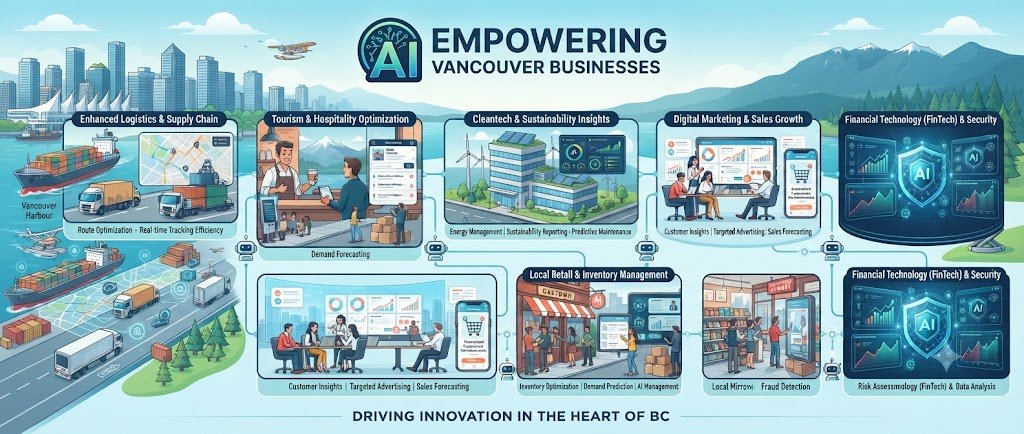
If you run a business in Vancouver, you’ve probably asked yourself this question while watching a competitor respond to customer emails faster than you can, or while wondering why your team spends half the week on spreadsheets that should take minutes. How can AI help Vancouver businesses? In short: it takes over the repetitive, time-consuming work — customer replies, data entry, follow-ups, scheduling, reporting — so your team can spend their energy on the things that actually grow the business.
This isn’t about replacing people or chasing hype. It’s about giving a local bakery, a law office in Gastown, a moving company in Burnaby, or a growing tech startup on Granville Street a practical way to do more with the staff and budget they already have. Below, we’ll walk through exactly where AI fits into a Vancouver business, what it costs to get started, and what to watch out for.
What Does “AI for Business” Actually Mean?
When people ask how can AI help Vancouver businesses, they’re usually picturing something complicated — robots, code, a six-figure IT project. In practice, it’s much simpler. Business AI today mainly falls into a few categories:
- Conversational AI — chatbots and virtual assistants that answer customer questions on your website or social channels, day or night.
- Automation — software that handles repetitive tasks like invoice processing, appointment reminders, or lead follow-up without a person clicking through each step.
- Data and analytics — tools that sort through sales, customer, or website data and flag patterns a person might miss.
- Content and marketing support — AI-assisted writing, personalization, and campaign optimization.
Most Vancouver businesses don’t need all four at once. The right starting point depends on where your time is actually going.
Why Are So Many Vancouver Businesses Turning to AI Right Now?
Vancouver’s business costs — commercial rent, wages, and general overhead — are among the highest in Canada. That pressure is exactly why AI has moved from “nice to have” to a real consideration for small and mid-sized companies here. When you can’t easily hire another full-time employee, automating three or four hours of manual work a week starts to matter.
There’s also a national push behind this shift. Innovation, Science and Economic Development Canada (ISED) has published guidance recognizing that adopting AI can boost productivity, unlock innovation, and support economic growth for small and medium-sized businesses, while also acknowledging that smaller companies often face real barriers to adoption — cost, complexity, and limited in-house expertise chief among them. That’s a fair summary of what most Vancouver business owners are navigating: the potential is real, but so is the learning curve. ISED Canada
How Can AI Help Vancouver Businesses With Customer Service?
This is usually the first place people look, and for good reason. A simple AI chatbot on your website can:
- Answer common questions (hours, pricing, availability, order status) instantly
- Capture a lead’s contact details when your team isn’t online
- Route more complex questions straight to a human, with context already gathered
A Vancouver moving company, for example, might use a chatbot to answer “do you service North Vancouver?” or “what’s your minimum for a studio move?” at 9 p.m. on a Sunday — capturing the booking instead of losing it to a competitor who answers first thing Monday.
How Can AI Help Vancouver Businesses Save Time on Daily Tasks?
Automation is where the time savings really add up. Instead of a person manually re-entering customer details between your booking system and your CRM, or sending the same follow-up email one contact at a time, automation tools can do it in the background. Common examples for local businesses include:
- Auto-generating invoices once a job is marked complete
- Sending appointment reminders without manual scheduling
- Syncing new leads from your website directly into your CRM
- Flagging overdue follow-ups so nothing falls through the cracks
None of this requires rebuilding your systems from scratch — most of it connects to tools you’re already using.
How Can AI Help Vancouver Businesses Improve Sales and Marketing?
AI doesn’t write your marketing strategy for you, but it does make execution faster. Practical, realistic uses include:
- Personalizing email campaigns based on what a customer previously bought or browsed
- Scoring leads so your sales team calls the most promising ones first
- Drafting first versions of ad copy or product descriptions for a human to refine
- Analyzing which pages or offers are actually converting visitors into customers
For a Vancouver retailer or service business competing with national chains, this kind of targeting can matter more than a bigger ad budget.
How Can AI Help Vancouver Businesses Make Sense of Their Data?
Most small businesses are sitting on more useful data than they realize — sales trends, website traffic, customer feedback — but don’t have time to dig through it. AI-powered analytics tools can summarize that data into plain-language insights: which products sell best by season, which marketing channel brings in the most repeat customers, or where customers tend to drop off before completing a purchase. The value isn’t the technology itself; it’s the decisions it lets you make faster.
What Should a Vancouver Business Know About AI Privacy and Security?
This is a fair question to ask before adopting anything. A few practical points:
- Know where your data is stored. Some AI tools process data outside Canada, which matters if you handle sensitive customer information.
- Check vendor security practices. Ask how customer data is encrypted, stored, and who has access to it.
- Start with lower-risk use cases. Customer FAQs and internal automation carry far less risk than tools handling financial or health information.
- Review contracts carefully, especially around data ownership and retention.
The federal government’s own resources on AI procurement reflect this same caution — Canada maintains a public list of AI suppliers recognized for responsible and effective AI services, which, while built for public-sector buying, is a useful reference point for any Vancouver business vetting an AI vendor. ISED Canada
How Much Does AI Implementation Cost for a Vancouver Business?
There’s no single number here, and any provider who quotes one without understanding your business first should raise a flag. Cost generally depends on:
- Whether you’re adopting an off-the-shelf tool or something custom-built
- How many systems it needs to connect with (your CRM, website, payment processor, etc.)
- The volume of customer interactions or data involved
- Ongoing maintenance and support needs
Many Vancouver businesses start small — a single chatbot or one automated workflow — and expand once they see where it actually saves time. That staged approach also lines up with how ISED describes the national picture: many companies see AI’s potential but hold back due to cost, access to expertise, and uncertainty about where to start, which is exactly why a phased rollout tends to work better than an all-at-once overhaul.
How Do You Know If AI Is Actually Worth It for Your Business?
Before investing anything, it helps to ask a few honest questions:
- Where is your team currently spending time on repetitive, low-value tasks?
- Are you losing leads or customers because you can’t respond fast enough?
- Do you have data you’re not currently using to make decisions?
- Would freeing up 5–10 hours a week actually change how your business operates?
If the answer to any of these is yes, that’s usually a good starting point — not a sign you need to automate everything at once.
How Can a Vancouver Business Get Started With AI the Right Way?
The businesses that get real value from AI tend to follow a similar pattern: they pick one clear problem, solve it well, measure whether it worked, and only then move to the next one. Trying to automate everything in month one is where most frustration comes from.
If you’re weighing your options, our AI solutions Vancouver page breaks down the specific services we offer for local businesses — from chatbots to workflow automation to CRM integration — so you can see what actually fits your situation.
Is There a Simple Way to Sum Up How AI Helps a Vancouver Business?
At its core, the answer to how can AI help Vancouver businesses comes down to time and clarity. AI takes the repetitive, predictable work off your plate and gives you a clearer picture of your own data, so you and your team can focus on customers, strategy, and growth — the parts of the business that actually need a human.
Vancouver’s mix of high costs and strong competition makes this more than a passing trend; it’s becoming a practical way for local businesses to stay efficient without stretching their teams thin. Whether you’re just curious or ready to explore your first automation, starting with one well-chosen project is almost always the smartest move.
If you’d like a straightforward conversation about where AI could realistically fit into your business — no pressure, no jargon — the team at Global Tech Mind is happy to walk through your options and help you figure out a sensible starting point.
Frequently Asked Questions
How can AI help Vancouver businesses that don't have an IT team?
Most modern AI tools are designed to be managed without in-house technical staff. A local provider can handle setup, integration, and ongoing support, so you don’t need a dedicated IT department to benefit.
Is AI only useful for large companies in Vancouver?
No — many of the most practical use cases (chatbots, automated follow-ups, appointment reminders) are actually built with small and mid-sized businesses in mind, since that’s where time savings matter most.
How long does it typically take to see results from AI adoption?
It varies by use case, but simple tools like a customer service chatbot or an automated workflow can start saving time within the first few weeks of proper setup.
Does using AI mean my business data leaves Canada?
Not necessarily — it depends on the specific tool and vendor. It’s worth asking any provider directly where data is stored and processed before signing on.