AI in finance can be defined as the employment of artificial intelligence-based technologies to analyze information, find patterns, automate processes, detect anomalies, assist decision-making, and enhance the customer experience. While conventional computer software usually operates in accordance with pre-defined rules set by programmers, AI systems are capable of detecting patterns in the data and leveraging these patterns to generate predictions, classification, recommendations, or other types of output. In financial services, this is valuable since companies often have to deal with substantial amounts of structured and unstructured data. The examples of such data can include transactions, interactions with customers, documents, market data, applications, invoices, emails, and risk indicators. Hence, for firms based in Vancouver, AI in finance can be much more than employing chatbots. Depending on the specific use case, AI can help with detecting fraud, document processing, customer service, financial forecasts, compliance processes, risk assessment, and other internal processes. It should be noted that just because AI is being used in a financial process does not necessarily mean that it is useful. The value of AI in finance depends on the quality of data, workflow design, controls, human supervision, security measures, and alignment with the business problem. How Does AI in Finance Work? In very broad terms, an AI-driven financial system accepts some data as input, performs some calculations via an algorithm or model, outputs something, and then allows a person or another system to do something with that output. A simple flow might look like this: Financial data → Data preparation → AI model → Analysis/Prediction → Action → Monitoring As an example, think about a system whose purpose is to detect any unusual transactions. It starts with transaction data being fed into the system. The data relevant to the problem is then cleaned and prepared. The AI model analyzes the patterns within the data. Any behavior that diverges from the normal pattern is detected by the system. Some kind of risk score or alert is generated. This is then reviewed by a financial expert or some other controlled process. Monitoring and feedback determine if the system is functioning as expected. Of course, each particular solution can have very different architecture. Machine learning, rules, statistics, NLP, computer vision, generative AI and many more are used in combination. What Data Can Financial AI Use? According to use case requirements, AI systems might utilize: Transaction logs Customer data Financial reports Invoices and receipts Loan applications Insurance forms Email communications Market and economy data Account activities Internal company data Data concerning compliance and regulation Sensitive financial data requires special care to be taken. Data access, storage, privacy, cybersecurity, permission, model monitoring, and audit should be taken into account before implementing AI. According to the Government of Canada, the implementation of AI in banking creates opportunities and threats including privacy issues, cybersecurity, misinformation, and fraud. What Technologies Are Used in AI in Finance? However, AI in finance is not one technology only. It is an umbrella term for various technological solutions. Machine Learning Machine learning is able to detect patterns in historical information and make classification or generate predictions based on them. Various financial institutions can use machine learning technology for applications like fraud detection, risk analysis, customer segmentation, and forecasting. Natural Language Processing NLP stands for natural language processing, which means that the software is able to handle human language. The technology can be used by financial institutions for analyzing customer’s messages, extracting information from documents, classifying messages, or providing conversational support. Generative AI Generative AI is capable of generating various types of text, including summaries, explanations, structured information, and other content based on the input information. In the context of finance, some safe applications may include document summarization, internal knowledge assistants, research, and customer service assistant tools. Nevertheless, generative AI can generate wrong information. That is why proper validation and human review process should be established in financial organizations. Computer Vision Computer vision helps to analyze pictures and scanned documents. Among possible applications are information extraction from financial documents, invoices, ID documents, and other types of documents. What Are the Main Uses of AI in Finance? Use cases of AI in finance depend on many factors including firm, regulatory landscape, data availability, and goals. Fraud Detection Fraud detection is among the most frequently mentioned use cases of AI in finance. AI algorithm is capable of assessing the behavior of transactions and detecting anomalies. As opposed to rule-based approach, some systems can take into account several signals at once. For instance, such a system could look at: Transaction frequency Transaction amount Geographical signals Account behavior Device signals Patterns in history Change in usual behavior An alert does not necessarily mean that there was any fraud taking place. It just means that further investigation is necessary. 2. Risk Analysis Various risks should be managed by the financial organizations. AI will help the analysts in working on large sets of data and uncovering relationships which can be hard to uncover through manual work. Some examples include: Credit risk analysis Operational risk management Fraud risk analysis Portfolio analysis Financial forecasting Scenario analysis Human intervention is required where there are serious financial implications involved. 3. Customer Service AI-driven bots can assist in addressing everyday consumer inquiries. For instance, a financial chatbot could assist customers in comprehending: Accounts and procedures Frequently asked questions Services availability General product information Document requirements Basic account support procedures The Financial Consumer Agency of Canada mentions that AI is found in the banking sector in forms of virtual assistants and chatbots. 4. Document Processing Financial firms deal with a lot of documentation. AI can assist in extracting information from: Invoices Statements Applications Contracts Receipts Forms Reports Rather than manually copying all the fields into other systems, an AI-enabled workflow can assist in extracting the required information and sending it into a structured process for verification. It is especially helpful where documentation processes are bogging down the employees. 5. Financial Forecasting Companies can apply AI-assisted forecasting to review past data in order
What Is Cloud Processing?
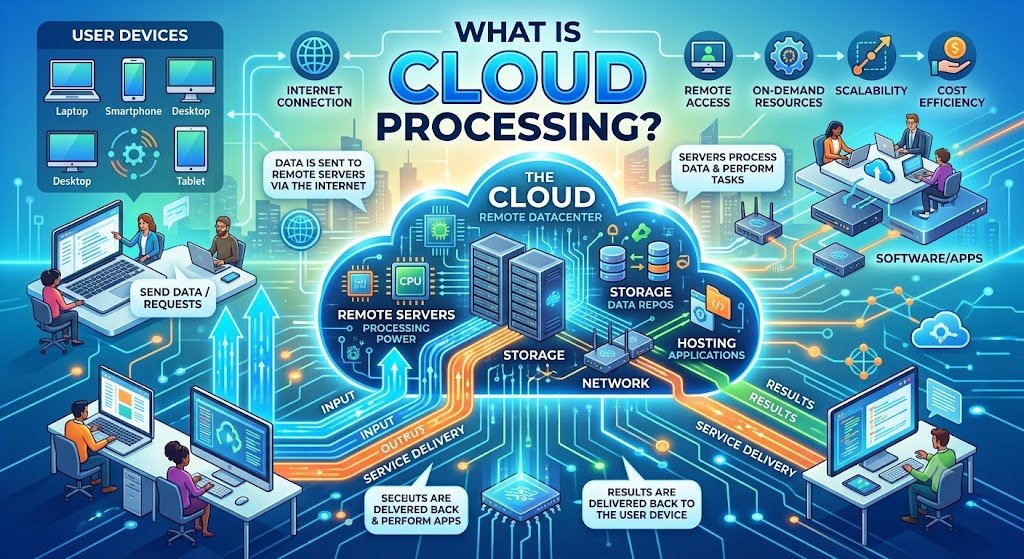
Cloud processing refers to the processing of data, running applications, performing computations, and generating results using external computing resources over the internet rather than fully depending on a computer or an internal server for such activities. Simplified, the idea behind cloud processing is to shift the burden of processing tasks from a single computer by distributing the load across multiple cloud servers, processing the information, and then giving back the desired output. It is directly related to cloud computing, which involves the provision of resources like computational capabilities, storage, databases, networking, software, and analytics over the cloud infrastructure. According to the Government of Canada, cloud computing refers to the delivery of computing services over the internet based on the demand for such resources. Cloud processing can be useful for business applications, websites, analytic services, AI applications, automated tasks, customer portals, and other digital services offered by businesses operating in Vancouver. What Does Cloud Processing Mean? With cloud computing, part or all of the computing needed to fulfill the needs of the application happens on remote infrastructure, and not just on the device of the user. This happens when the document that the user uploads to the application goes through the cloud infrastructure of the application. The cloud infrastructure could then process the file, extract the information from it, make computations or use an AI algorithm before delivering the result. This is a simplified version of how things happen: User/Application → Internet → Cloud Infrastructure → Processing of Data → Result → User/Application It is much more complicated in reality, but this is the fundamental concept. How Does Cloud Processing Work? Cloud processing generally involves several interconnected components. 1. A User or Application Sends a Request The process begins when an application needs computing resources. Examples include: Uploading a document Running an analytics report Processing an image Sending a customer request Running an AI model Generating a business report Performing a database query The request is transmitted to the relevant cloud environment. 2. Cloud Infrastructure Receives the Workload The cloud environment provides access to computing resources such as: Virtual machines Containers CPUs GPUs Memory Storage Databases Networking resources The specific infrastructure depends on the application and workload. 3. The Workload Is Processed Cloud servers perform the required computation. For example, a cloud application might: Analyze customer data Resize an image Process a video Calculate financial information Search a database Run machine-learning inference Generate a report 4. The Result Is Returned After processing is completed, the application receives the result. The user may see: A report A recommendation A processed document A search result An AI-generated response Updated information on a dashboard The user does not necessarily need to know which physical server performed the computation. What Is the Difference Between Cloud Processing and Local Processing? The main difference is where the computing work takes place. Cloud Processing Local Processing Processing occurs on remote infrastructure Processing occurs on the user’s device or local server Resources can be scaled according to workload Resources depend on available local hardware Can support distributed applications Often limited to local infrastructure Internet or network connectivity is commonly required Can often operate without internet Infrastructure is managed through cloud services or providers Organization manages its own hardware or devices Neither approach is automatically suitable for every situation. Some applications benefit from cloud processing, while others may require local or edge processing because of latency, connectivity, privacy, hardware, or operational requirements. What Are the Main Types of Cloud Processing? There are various kinds of cloud processing based on the type of architecture in place. Centralized Cloud Processing The central cloud will perform most of the processing activities in the application. This is a popular approach in web applications, databases, business systems, and central analytics. Distributed Cloud Processing The workload is distributed over various computing sources. This will enable applications to manage bigger workloads or operate at various locations. Serverless Processing The serverless approach enables developers to run the functions of the applications without using the normal servers. The cloud provider will manage most of the infrastructure in such cases while applications run various tasks upon triggering. Cloud-Based AI Processing The AI application can upload the data into cloud infrastructure, and the machine-learning or generative-AI models will do the task of processing the request. It can be very helpful when such AI models need high amounts of computing power which cannot be obtained on usual devices. Hybrid Processing In some cases, there can be both local and cloud processing of certain workloads. Such an approach will help organizations which require a mix of local management, low latency, central processing, and cloud scalability. What Are the Benefits of Cloud Processing? There could be various advantages of cloud processing. Scalability Cloud infrastructure enables organizations to scale computing resources up and down depending on the requirements. For instance, there could be a need to have significantly more computing power during a huge sales day for an e-commerce application than during the quieter periods. Elasticity, as one of the features of cloud computing, is mentioned by The Government of Canada as a way to grow or shrink cloud resources depending on the requirements. Flexible Computing Resources An organization can acquire computing resources without having to acquire and maintain all the infrastructure needed for it. Support for Remote Applications Cloud processing enables applications and services to run across distributed environments. It is helpful for organizations with remote employees, offices, customers in other regions, and online services. Faster Deployment Cloud infrastructure provides access to computing, storage, networking and other services which developers can utilize when building applications. Potential Cost Efficiency Cloud services allow avoiding the necessity to purchase infrastructure for each potential peak load. However, cloud computing does not mean cost reduction. It depends on architecture, resource utilization, storage, data transfers, licensing, monitoring and other elements. Support for Large Workloads Cloud environment provides the possibility Cloud Processing vs Cloud Storage Cloud computing and cloud storage are similar but different concepts. Cloud storage is storing data

What Is Artificial Intelligence AI?
In case you are curious about what is artificial intelligence AI, it is a technology that allows computer systems to perform those tasks that require human intelligence. Those tasks may include understanding language, recognizing patterns, analyzing information, creating content, making predictions, and assisting with business decision-making. The modern AI integrates machine learning, natural language processing, computer vision, generative AI, and predictive analytics. The real value of AI for business lies not only in using AI technology but in solving real-life problems with AI technologies. When businesses try to find out what is artificial intelligence AI, they should also be aware that AI could be implemented in different ways, from simple customer service chatbots to more complex systems of business data analysis. How Does Artificial Intelligence Work? In the simplest terms, AI technology takes in data, finds patterns in them, and gives out a result according to its training, rules, model, or any related information. Machine learning AI can get better at what it does by learning through data, while generative AI can create text, images, computer code, and other outputs. The Government of Canada has further information about artificial intelligence and its use. Government of Canada — Artificial Intelligence Defining artificial intelligence AI also entails the understanding that the output from artificial intelligence must be assessed properly, especially where there is customer information, financial information, personal information, and other business-related information involved. How Can AI Help Businesses? AI technology will allow companies to handle repetitive and data-heavy tasks and enable employees to attend to more valuable tasks. Some examples include: AI-enabled customer services and chatbots Lead generation and follow-ups Documentation and data handling Forecasting and prediction Content and knowledge management Workflow automation Customized customer experience Business assistants Data analysis and reporting Companies interested in implementing this technology are recommended to get in touch with AI Solutions Vancouver for more information. AI Automation for Business Processes Just knowing what artificial intelligence is AI is just the first step. What follows is the recognition of repetitive tasks which can benefit from being automated. AI automation can help link applications, manage information feeds, initiate workflows, categorize documents, answer standard queries, and transfer data within business systems. Learn more about AI Automation Services Vancouver and discover how workflow automation can be utilized in your daily business processes. Industries Using Artificial Intelligence Artificial intelligence can be customized for various uses within industries as follows: E-commerce Industry Product suggestions, customer service, stock management, and personal messaging. Professional Industry Contract analysis, scheduling, reports, documentation and knowledge management, and administrative automation. Healthcare Industry Administrative processes, documentation, appointments, and communication. Real Estate Industry Prospect screening, property data analysis, communication, and workflow automation. Finance and Business Operations Industry Reports, anomaly detection, documentation, forecasting, and operations analytics. Our AI Implementation Process As businesses seek information about artificial intelligence (AI), there is usually the need for an explanation of how to start. The process of implementing AI may consist of the following steps: Business Assessment – Discovering problems, repetition, and other opportunities. AI Strategy – Choosing proper AI technologies and defining specific goals. Solution Development – Creating or developing necessary AI technology. Testing – Assessing accuracy, usability, security, and performance of work flow. Deployment – Implementing the solution in the business. Optimization – Monitoring and improving the system. Why Choose Global Tech Mind? Global Tech Mind focuses on practical technology solutions designed around business requirements. Our approach connects AI capabilities with existing workflows, software, websites, applications, and operational processes rather than treating AI as a standalone technology. If you are still asking what is artificial intelligence AI and whether it can provide measurable value for your organization, a business-focused consultation can help identify realistic opportunities, technical requirements, and potential automation areas. Conclusion What is artificial intelligence AI? In simple terms, it is the use of intelligent computer systems to analyze information, recognize patterns, generate outputs, and assist with tasks that traditionally require human intelligence. For businesses, the most useful AI applications are those that solve specific operational, customer-service, analytical, or automation challenges. Global Tech Mind can help businesses evaluate AI opportunities and turn suitable use cases into practical technology solutions. Ready to explore AI for your business? Contact Global Tech Mind to discuss your requirements and identify where artificial intelligence can fit into your existing operations. FAQs What is artificial intelligence AI in simple terms? What is artificial intelligence AI in simple terms? It is technology that enables computers to perform tasks such as understanding language, recognizing patterns, analyzing data, generating content, and making predictions. What are common examples of AI? Examples include AI chatbots, recommendation systems, voice assistants, fraud detection, predictive analytics, computer vision, and generative AI tools. Can small businesses use AI? Yes. Small businesses can start with focused applications such as customer-support chatbots, lead management, document processing, reporting, or workflow automation. Is AI the same as automation? No. Automation generally follows predefined rules, while AI can analyze information, recognize patterns, and generate or predict outputs. They can also work together in AI-powered automation workflows. What is artificial intelligence AI in simple terms? It is technology that enables computers to perform tasks such as understanding language, recognizing patterns, analyzing data, generating content, and making predictions. Examples include AI chatbots, recommendation systems, voice assistants, fraud detection, predictive analytics, computer vision, and generative AI tools. Yes. Small businesses can start with focused applications such as customer-support chatbots, lead management, document processing, reporting, or workflow automation. No. Automation generally follows predefined rules, while AI can analyze information, recognize patterns, and generate or predict outputs. They can also work together in AI-powered automation workflows.

When Should a Business Hire an AI Consultant?
Most Vancouver businesses don’t struggle with a lack of AI tools — they struggle with knowing which ones are worth the investment. That’s where an experienced AI Consultant earns their keep: cutting through the noise, mapping AI to your actual operations, and helping you avoid the expensive trial-and-error that comes with adopting technology on your own. At Global Tech Mind, we work as your AI Consultant on the ground in Vancouver — reviewing your workflows, identifying where automation and AI genuinely move the needle, and building a plan your team can realistically execute. No generic playbooks. No overselling tools you don’t need. What Does an AI Consultant Actually Do? An AI Consultant isn’t there to sell you software. The role is closer to a translator between business problems and technical solutions. Concretely, that means: Auditing current processes to find where manual work is slowing the business down Assessing whether AI, automation, or simpler process fixes are the right answer (sometimes it’s not AI at all) Recommending tools and platforms that fit your budget, team size, and technical maturity Planning data readiness, since most AI projects fail on messy or missing data, not the model itself Guiding implementation and staff training so adoption actually sticks Measuring outcomes against business KPIs, not vanity metrics If you’ve searched for an AI consultant near me or wondered whether AI adoption is worth the cost for a company your size, this is generally the starting point. Why Vancouver Businesses Are Turning to AI Consulting Vancouver’s mix of tech-forward startups, established retail and logistics firms, and professional service companies creates a wide range of AI needs — which is exactly why generic, US-templated AI advice often falls flat here. A local AI Consultant brings context that matters: familiarity with BC’s labour market and hiring costs, Canadian data privacy obligations under PIPEDA, and the operational realities of running a business in a city where both real estate and talent come at a premium. Businesses here aren’t looking for AI for its own sake — they’re looking for ways to do more with the teams they already have. Our AI Consulting Services in Vancouver AI Readiness Assessment Before recommending any tool, we evaluate your current systems, data quality, and team capacity. This tells us whether you’re ready for AI adoption now or need groundwork first — and prevents you from spending on tools that won’t deliver. AI Strategy & Roadmap Development We build a phased plan tied to specific business outcomes: reducing response times, cutting manual data entry, improving forecasting accuracy, or freeing up staff hours for higher-value work. Process Automation Consulting Not every problem needs a large language model. Sometimes rules-based automation solves it faster and cheaper. Our recommendations are based on what actually fits, not what’s trending. AI Tool Selection & Vendor Evaluation With hundreds of AI platforms on the market, picking the right one is a research project on its own. We shortlist, test, and compare tools against your specific requirements before you commit budget. Implementation Oversight & Change Management Tool selection is the easy part — getting a team to actually use a new system is harder. We support rollout, documentation, and training so the investment doesn’t sit unused after month one. Ongoing AI Governance & Optimization AI systems need monitoring, retraining, and periodic review. We help set up governance practices so outputs stay accurate and compliant over time. Related service: our team also delivers hands-on implementation through AI Solutions Vancouver, for businesses ready to move from strategy into execution. Benefits of Working With a Local AI Consultant Reduced wasted spend — you avoid buying tools that don’t match your actual workflow Faster decision-making — a structured evaluation process beats months of internal debate Realistic timelines — plans built around your team’s actual bandwidth, not an idealized one Local compliance awareness — guidance that accounts for Canadian privacy and data rules Measurable outcomes — every recommendation tied to a metric you can track Reduced internal risk — an outside perspective catches blind spots your team may miss Our AI Consulting Process Discovery Call We start by understanding your business, current challenges, and what “success” would actually look like — no assumptions. Operational & Data Audit We review your existing tools, data sources, and workflows to identify realistic opportunities for AI or automation. Strategy & Roadmap You receive a clear, prioritized plan — what to implement first, what can wait, and expected impact for each step. Pilot & Testing Rather than a full rollout on day one, we test recommendations on a smaller scale to confirm results before scaling up. Implementation Support We help your team integrate the chosen tools, including documentation and training where needed. Review & Optimization We check in on performance against the original goals and adjust the approach as your business evolves. When Should a Business Hire an AI Consultant? There’s no single “right” moment, but a few situations tend to be strong signals it’s time to bring one in: Situation Why It Matters Your team spends hours weekly on repetitive manual tasks Signals a clear automation or AI opportunity with fast ROI You’ve tried an AI tool and it didn’t deliver results Often a sign of poor fit or missing groundwork, not a bad tool You’re scaling and can’t hire fast enough to keep up AI/automation can offset growing operational load Leadership is unsure which AI investments are worth it An outside assessment removes guesswork and internal bias Competitors are adopting AI and you’re unsure where you stand A gap analysis clarifies whether you’re actually behind If more than one of these applies, it’s usually the right time to bring in an AI Consultant rather than continuing to research tools internally without a clear framework. Industries We Serve in Vancouver Professional services (legal, accounting, consulting) Retail and e-commerce Logistics and supply chain Healthcare administration Real estate and property management Manufacturing and light industrial Financial services Each industry has different data structures, compliance requirements, and tolerance for risk — our

What Artificial Intelligence Services Do Businesses Need?
Artificial Intelligence Services can help Vancouver businesses solve practical problems—not simply add another technology to their software stack. From automating repetitive work to improving customer support, analysing business data, and connecting disconnected systems, AI can be applied where it creates measurable operational value. The important question is not whether a business should use AI. It is where AI can genuinely improve the way the business works. For a growing company, the right Artificial Intelligence Services should fit existing processes, systems, customer expectations, data requirements, and long-term business goals. Global Tech Mind helps Vancouver businesses identify suitable AI opportunities and turn them into practical digital solutions. What AI Services Do Businesses Actually Need? Not every company needs a complicated AI platform. A local service business may benefit more from an intelligent chatbot and lead automation, while an established company may need predictive analytics, document processing, CRM automation, or a custom AI application. Common AI requirements include: AI consulting and business use-case discovery Custom AI application development AI-powered chatbots and virtual assistants Business process and workflow automation AI-powered customer support Document and data processing Predictive analytics and forecasting AI-powered search and knowledge systems Recommendation and personalization systems CRM and business-system AI integration Generative AI applications AI API and third-party platform integration AI maintenance, monitoring, and improvement The right solution depends on the problem being solved, the quality of available data, existing software, security requirements, and the expected business outcome. How Can Artificial Intelligence Services Help Vancouver Businesses? The value of AI becomes clearer when it is connected to a real business task. Reduce repetitive administrative work Employees often spend significant time on repetitive activities such as data entry, document handling, email responses, reporting, appointment management, and information retrieval. AI automation can reduce manual steps while allowing employees to focus on higher-value responsibilities. Improve customer response times AI chatbots and virtual assistants can answer common questions, guide website visitors, qualify leads, and provide information outside normal business hours. For businesses receiving enquiries through websites, social media, or messaging platforms, this can create a more consistent customer experience. Turn business data into useful insights AI can analyse large volumes of structured and unstructured information to identify trends, patterns, anomalies, and opportunities. Businesses can use these insights to support forecasting, marketing decisions, sales planning, inventory management, and customer analysis. Connect disconnected systems Many businesses rely on multiple tools for CRM, accounting, email, customer service, inventory, marketing, and operations. AI can work alongside integrations and automation workflows to help move information between systems and reduce unnecessary manual handling. Create more personalised experiences AI can help businesses understand customer behaviour and deliver more relevant recommendations, content, responses, or offers. The objective should be useful personalisation—not simply collecting more customer information. What Artificial Intelligence Services Does Global Tech Mind Provide? Global Tech Mind develops AI solutions around specific business requirements rather than offering a one-size-fits-all package. AI Consulting and Strategy We begin by understanding the business process, current technology, available data, operational challenges, and desired outcomes. The goal is to identify AI opportunities that are realistic, useful, and commercially sensible. Custom AI Application Development Businesses with unique requirements may need a custom AI-powered application instead of an off-the-shelf tool. We can help plan and develop AI applications around specific workflows, users, business rules, and integrations. AI Chatbots and Virtual Assistants AI-powered chatbots can support customer enquiries, lead qualification, internal knowledge access, FAQs, appointment requests, and product or service discovery. For businesses that receive a high volume of repetitive questions, a properly designed chatbot can become an additional customer-service channel. AI Workflow Automation AI can be combined with workflow automation to handle tasks such as: Lead qualification Email classification Document processing Data extraction Follow-up reminders CRM updates Report generation Internal approvals Customer support routing This is particularly useful when employees repeatedly move information between different systems. AI Data Analytics Businesses can use AI to analyse operational and customer data and identify meaningful patterns. Depending on the use case, this may include forecasting, customer segmentation, anomaly detection, trend analysis, or decision-support dashboards. Generative AI Solutions Generative AI can support business activities such as content drafting, document summarisation, knowledge retrieval, internal assistance, customer communication, and research workflows. The implementation should include appropriate controls for accuracy, privacy, permissions, and human review. What Are the Benefits of Artificial Intelligence Services? Well-planned Artificial Intelligence Services should produce a practical business benefit rather than simply demonstrate new technology. Potential benefits include: Greater operational efficiencyAutomate repetitive processes and reduce unnecessary manual work. Faster customer responseProvide immediate answers to common questions and route more complex enquiries to employees. Better access to informationHelp employees find useful information across documents, systems, and internal knowledge sources. Improved decision supportAnalyse business information and highlight patterns that may otherwise be difficult to identify. Scalable operationsSupport increasing workloads without requiring every process to grow at the same rate as headcount. More consistent workflowsReduce variations caused by repetitive manual processes. Better customer experiencesUse relevant information and automation to create faster and more convenient interactions. The actual return depends on the use case, implementation quality, data, adoption, and ongoing optimisation. How Do We Develop AI Solutions for Businesses? A practical AI project should start with the business problem—not the technology. Understand the Business We discuss the current workflow, challenges, customers, employees, software systems, and business objectives. Identify AI Opportunities We assess where AI could realistically improve efficiency, customer experience, decision-making, or automation. Define the Solution The next step is to determine the required features, integrations, data sources, user roles, security considerations, and technical architecture. Build and Integrate The solution is developed and connected with relevant business platforms, APIs, databases, CRM systems, websites, or internal tools. Test With Real Scenarios Testing should focus on actual business situations rather than only technical functionality. AI outputs, edge cases, permissions, integrations, and user experience are reviewed before launch. Launch and Improve After deployment, performance can be monitored and the system improved based on user feedback, business results, and changing requirements. Which Vancouver Industries Can Benefit From AI? Artificial

AI Companies in Vancouver: Custom AI Solutions by Global Tech Mind
Vancouver’s business scene is moving fast, and companies that adopt artificial intelligence early are the ones pulling ahead. If you’ve been comparing AI companies in Vancouver to find a partner who actually understands your industry, your data, and your goals, Global Tech Mind was built for exactly that. We design, build, and deploy AI systems — from intelligent chatbots to predictive analytics and workflow automation — for Vancouver businesses that want measurable results, not buzzwords. Every engagement starts with your business problem, not a generic template. Explore our full range of AI solutions in Vancouver or keep reading to see how we compare to other AI companies in Vancouver. Why Global Tech Mind Stands Out Among AI Companies in Vancouver Vancouver has no shortage of agencies calling themselves AI experts. Here’s what actually sets us apart: Local presence, local understanding — We work directly with Vancouver businesses, so we understand the regulatory environment, market conditions, and competitive pressures you’re dealing with. Custom-built, not off-the-shelf — We don’t resell templated chatbots. Every AI model or automation workflow is built around your data and your workflows. Transparent process — You get clear timelines, honest cost breakdowns, and regular progress updates — no black-box development. Proven delivery track record — Our team has shipped AI projects across retail, healthcare, logistics, finance, and professional services. Long-term partnership, not a one-off project — We stay involved after launch to monitor performance, retrain models, and refine automation as your business grows. When you compare AI companies in Vancouver side by side, the difference usually comes down to whether the team treats AI as a product to sell or a solution to build. We do the latter. Our AI Services in Vancouver AI Chatbots & Virtual Assistants Custom-trained conversational AI that handles customer support, lead qualification, and appointment booking — integrated directly with your website, CRM, or WhatsApp. Predictive Analytics & Business Intelligence We turn your existing data into forecasts you can act on — demand planning, churn prediction, inventory optimization, and revenue modeling. Process Automation (AI + RPA) We identify repetitive, manual tasks across your operations and automate them using AI-driven workflows, cutting turnaround time and human error. Natural Language Processing (NLP) Solutions Document summarization, sentiment analysis, contract review automation, and intelligent search — built for teams drowning in unstructured text. Computer Vision Applications Quality inspection, inventory tracking, and security monitoring powered by custom-trained vision models. AI Strategy & Consulting Not sure where to start? We audit your current systems and data maturity, then build a phased AI adoption roadmap tailored to your budget and goals. Each of these services connects back to our core offering — see the complete breakdown on our AI solutions Vancouver page. Our AI Development Process Discovery & Audit We assess your current data, systems, and business goals to identify where AI creates the fastest, most measurable impact. Solution Design Our team designs a custom architecture — model selection, integration points, and success metrics — before writing a single line of code. Build & Train We develop and train the AI model or automation workflow using your real data, iterating with your team along the way. Testing & Quality Assurance Every solution is stress-tested for accuracy, edge cases, and performance before it touches production. Deployment & Integration We launch the solution inside your existing tools — CRM, website, ERP, or internal dashboards — with minimal disruption. Monitoring & Optimization Post-launch, we track performance and retrain models as your data and business needs evolve. Industries We Serve in Vancouver Retail & E-commerce — demand forecasting, personalized recommendations, inventory automation Healthcare — appointment scheduling automation, administrative workload reduction, document processing Logistics & Supply Chain — route optimization, predictive maintenance, demand planning Financial Services — fraud detection, risk scoring, document automation Professional Services — client intake automation, contract analysis, reporting dashboards Real Estate — lead qualification bots, market analysis tools, virtual property assistants Because we’ve delivered across these sectors, we understand the industry-specific compliance and workflow challenges that generic AI companies in Vancouver often miss. Why Choose Global Tech Mind Vancouver-based team with direct, ongoing communication — no offshore black box Solutions built around your actual data, not generic pre-trained models Clear reporting on ROI and performance, not vague “AI transformation” promises Flexible engagement models: one-off projects, ongoing retainers, or full AI strategy partnerships A team that explains what the technology does in plain language, so your leadership team can make informed decisions If you’re evaluating AI companies in Vancouver and want a partner who treats your business goals as the starting point, not an afterthought, Global Tech Mind is ready to talk. For businesses researching how Canada is approaching AI governance and innovation policy, the Government of Canada’s Artificial Intelligence Strategy is a useful public resource on the national direction shaping AI adoption. Get Started With Global Tech Mind Choosing the right partner from the many AI companies in Vancouver shouldn’t feel like guesswork. Book a free strategy call with our team, and we’ll walk you through exactly where AI can save you time, cut costs, or unlock new revenue — with no pressure and no jargon. Conclusion Vancouver businesses that adopt AI thoughtfully — with the right partner and a clear strategy — consistently outperform those that wait. Global Tech Mind combines local presence, custom engineering, and a transparent process to help you move from “considering AI” to “running AI” without the usual guesswork. Whether you need a single automation workflow or a full AI roadmap, our team is ready to build it with you. Among the AI companies in Vancouver, we’re the one that starts with your business problem and ends with a measurable result. Frequently Asked Questions How do I choose the right AI company in Vancouver for my business? Look for a team that asks about your business goals before proposing a solution, shows past project results, and offers transparent pricing and timelines. Avoid vendors pushing generic, pre-built tools as a one-size-fits-all fix. How much does it cost

What Is Vancouver Known for in the AI Industry?
Vancouver has become one of Canada’s most recognized technology hubs, with a growing reputation for artificial intelligence research, AI startups, software innovation, skilled technology talent, and practical business adoption. But what is Vancouver known for in the AI industry? The answer goes beyond startups and research labs. Vancouver’s AI ecosystem brings together technology companies, researchers, entrepreneurs, universities, investors, and businesses looking for practical ways to use artificial intelligence. For businesses considering AI adoption, what is Vancouver known for in the AI industry? It is particularly known for combining strong technology talent with a collaborative innovation environment and access to Canada’s broader AI ecosystem. At Global Tech Mind, we help businesses turn these opportunities into practical digital solutions through AI development, automation, software development, and business-focused technology services. What is Vancouver known for in the AI industry today? What is Vancouver known for in the AI industry? Vancouver is known for its combination of AI research, technology entrepreneurship, software development, machine learning expertise, and growing commercial adoption. The city benefits from a strong technology community and access to skilled professionals across software engineering, data science, cloud computing, automation, and artificial intelligence. British Columbia is also receiving public-sector support aimed at accelerating AI commercialization and adoption across the province. For businesses, this creates an environment where AI is increasingly moving from experimentation into real-world applications such as customer service automation, predictive analytics, intelligent search, workflow automation, recommendation systems, and AI-powered business software. Why has Vancouver become an important AI technology hub? What is Vancouver known for in the AI industry? One major reason is the city’s ability to connect research, technology talent, entrepreneurship, and commercial innovation. Vancouver’s technology ecosystem supports companies developing software products as well as organizations adopting AI to improve existing operations. This combination matters because successful AI adoption is not only about developing advanced models. Businesses also need reliable software, useful data, secure infrastructure, automation workflows, and a clear implementation strategy. Canada’s current National AI Strategy also emphasizes AI adoption, skills development, commercialization, sovereign infrastructure, responsible AI, and the growth of Canadian technology companies. What AI technologies are businesses using in Vancouver? What is Vancouver known for in the AI industry? The city’s AI activity covers a broad range of technologies rather than one single application. Businesses can use AI for: AI-powered customer support and virtual assistants Intelligent business process automation AI voice assistants Document and data processing Predictive analytics Machine learning applications Generative AI solutions Recommendation engines Intelligent search and knowledge systems Lead qualification and sales automation CRM automation Workflow optimization AI-powered reporting and analytics Personalized customer experiences AI-enabled software and SaaS products The most valuable solution depends on the organization’s goals, available data, existing technology, and operational challenges. How can Vancouver businesses benefit from AI solutions? What is Vancouver known for in the AI industry? From a business perspective, its importance is closely connected to how AI can be applied to everyday operational challenges. AI can help businesses: How can AI reduce repetitive work? AI automation can handle repetitive activities such as data entry, document classification, lead routing, customer queries, appointment workflows, notifications, and routine reporting. This allows employees to spend more time on work that requires judgment, creativity, communication, and relationship building. How can AI improve customer experiences? AI-powered chatbots, voice assistants, recommendation systems, and intelligent support tools can help businesses respond to customers faster and provide more consistent service. How can AI support better business decisions? AI can analyze large volumes of business information and identify patterns that may otherwise be difficult to spot. When connected to reliable business data, AI-powered analytics can support forecasting, reporting, customer insights, and operational planning. How can AI help companies scale? Well-designed AI workflows can automate processes without requiring every additional task to be handled manually. This can make operations more efficient as customer volume and business activity increase. What AI services can Global Tech Mind provide for Vancouver businesses? What is Vancouver known for in the AI industry? It is increasingly associated with practical AI innovation, which means businesses need solutions that deliver measurable value rather than technology for technology’s sake. Global Tech Mind can help organizations plan, build, integrate, and improve AI-powered solutions. Our services can include: Can businesses automate workflows with AI? Yes. AI workflow automation can connect different business systems and automate tasks such as lead management, customer follow-ups, notifications, approvals, data processing, and internal workflows. Can Global Tech Mind develop AI-powered software? Yes. We can develop custom AI-enabled applications based on a company’s operational requirements, customer experience goals, and existing technology infrastructure. Can AI be integrated into existing CRM systems? AI can be connected with CRM platforms to support lead qualification, customer communication, sales workflows, data analysis, follow-ups, and automated task management. Can businesses use AI for customer support? AI-powered chat and voice solutions can help businesses answer common questions, collect information, route requests, and provide support outside traditional business hours. Can AI improve document processing? AI can extract information from documents, classify content, identify relevant data, and reduce manual processing for organizations handling large volumes of paperwork. Which industries can benefit from AI in Vancouver? What is Vancouver known for in the AI industry? Its impact extends across multiple sectors because AI can be adapted to different operational and customer requirements. Global Tech Mind can develop AI solutions for industries such as: Healthcare and medical services Education and training Real estate and construction Retail and eCommerce Finance and professional services Insurance Travel and hospitality Logistics and supply chain Recruitment and HR Legal services Manufacturing Sports and fitness Technology and SaaS The objective is not simply to add AI to a business. The objective is to identify where intelligent technology can solve a genuine business problem. How should a Vancouver business start an AI project? What is Vancouver known for in the AI industry? Understanding the ecosystem is only the first step. Businesses also need a practical implementation strategy. A typical AI project can follow this process: How do you identify the right
How Can AI Automate Business Tasks?
AI automates business tasks by handling repetitive processes such as data entry, lead qualification, customer support, appointment scheduling, email follow-ups, document processing, reporting, and workflow management. By connecting AI with existing business tools, companies can reduce manual work, improve accuracy, respond faster, and increase overall productivity while allowing employees to focus on more strategic tasks. What Business Tasks Can AI Automate? How Can AI Automate Business Tasks? Common applications include: Lead management: Capture, qualify, score, and route leads automatically. Customer support: Use AI chatbots to answer common questions and escalate complex requests. Data processing: Extract information from documents, emails, forms, and invoices. Marketing automation: Personalize campaigns, generate content, segment audiences, and automate follow-ups. Sales workflows: Schedule meetings, update CRM records, send reminders, and manage follow-ups. Reporting: Collect business data and generate recurring reports and summaries. Administrative work: Automate notifications, approvals, task assignments, and repetitive data entry. For businesses exploring broader AI adoption, our AI solutions Vancouver service can help connect AI capabilities with real business objectives. How Can AI Automation Improve Business Efficiency? How Can AI Automate Business Tasks? The biggest advantage is not simply replacing manual work. It is creating consistent workflows that operate faster and with fewer unnecessary steps. AI automation can help businesses reduce repetitive workload, respond to customers faster, improve data accuracy, and give teams more visibility into ongoing operations. It can also scale routine processes as the business grows without requiring the same increase in administrative effort. Canada is actively encouraging responsible AI adoption among businesses. The Government of Canada’s current AI strategy highlights productivity, SME adoption, responsible AI, and practical implementation as important priorities. What AI Automation Services Can Global Tech Mind Provide? How Can AI Automate Business Tasks? Global Tech Mind develops customized automation workflows based on how a business actually operates. Our services can include: AI workflow automation CRM and lead automation AI-powered customer support Chatbot development Document and data automation Email and notification automation AI-powered reporting Business process integration Custom AI applications API and software integrations Businesses looking for specialized workflow implementation can explore our AI automation services Vancouver offering. How Does AI Automation Work? How Can AI Automate Business Tasks? A typical implementation starts by identifying repetitive processes and measuring where automation can create measurable value. What Is the AI Automation Process? Process discovery: Identify repetitive and inefficient tasks. Automation planning: Select suitable AI tools, integrations, and workflows. Development: Build and connect the required automation. Testing: Check accuracy, reliability, security, and workflow performance. Deployment: Introduce the automation into daily operations. Optimization: Monitor results and continuously improve the workflow. This approach helps businesses adopt AI progressively rather than investing in unnecessary technology. Which Industries Can Benefit From AI Automation? How Can AI Automate Business Tasks? Almost any organization with repetitive digital processes can benefit. Common applications include healthcare, professional services, education, real estate, ecommerce, finance, logistics, hospitality, recruitment, and retail. For businesses that need automated customer conversations, Global Tech Mind also provides chatbot development company Vancouver solutions for websites, customer service, lead generation, and support workflows. Why Choose Global Tech Mind for AI Automation? How Can AI Automate Business Tasks? Global Tech Mind focuses on practical, business-specific automation rather than one-size-fits-all solutions. We combine software development, AI integration, workflow design, and business process understanding to create solutions aligned with your goals. Our focus is simple: automate the right tasks, integrate the right systems, and create measurable operational value. What Should Vancouver Businesses Automate First? Start with tasks that are repetitive, rules-driven, high-volume, time-consuming, or prone to human error. Lead follow-ups, customer FAQs, appointment scheduling, document processing, reporting, and CRM updates are often strong starting points. Conclusion: How Can AI Automate Business Tasks Effectively? How Can AI Automate Business Tasks? The most effective approach is to identify specific operational bottlenecks and automate them with a measurable business objective. For Vancouver companies, AI can become a practical productivity tool—not just an experimental technology. Global Tech Mind can help you evaluate your processes, design AI-powered workflows, integrate your existing systems, and build automation around your business needs. Ready to automate repetitive business work? Contact Global Tech Mind to discuss your AI automation requirements. FAQs How Can AI Automate Business Tasks for Small Businesses? AI can automate customer inquiries, lead qualification, appointment scheduling, document processing, email follow-ups, reporting, and other repetitive workflows. Is AI Automation Suitable for Vancouver Small Businesses? Yes. Small businesses can begin with one or two high-value processes and expand automation as they see measurable improvements. Can AI Automation Integrate With Existing Business Software? Yes. Depending on the software, AI workflows can connect through APIs, webhooks, databases, CRM integrations, and other integration methods. Can AI Automate Customer Support? Yes. AI chatbots can answer frequently asked questions, collect customer information, assist with basic requests, and transfer complex conversations to human teams. AI can automate customer inquiries, lead qualification, appointment scheduling, document processing, email follow-ups, reporting, and other repetitive workflows. Yes. Small businesses can begin with one or two high-value processes and expand automation as they see measurable improvements. Yes. Depending on the software, AI workflows can connect through APIs, webhooks, databases, CRM integrations, and other integration methods. Yes. AI chatbots can answer frequently asked questions, collect customer information, assist with basic requests, and transfer complex conversations to human teams.

Can Small Businesses in Vancouver Get Started With AI?
Yes, small businesses in Vancouver can start using AI without making a large investment. Businesses can begin with practical solutions such as AI chatbots, workflow automation, AI-powered CRM, virtual assistants, and data analysis. The best approach is to identify one repetitive or time-consuming task, implement a suitable AI solution, and measure its impact. Once the process works effectively, businesses can gradually expand AI across other operations. This makes AI adoption more manageable while helping Vancouver businesses improve efficiency, customer service, and everyday operations. Best AI solutions for small businesses in Vancouver, at a glance: AI chatbots for after-hours customer inquiries and lead capture AI-optimized Google Business Profile management for local search visibility AI bookkeeping and invoicing tools to cut admin hours AI content and social media assistants for consistent local marketing AI scheduling and booking systems for service-based businesses AI-powered review and reputation management to build trust with local customers Each of these solves a specific, common bottleneck for small teams — not a theoretical “future of work” problem. That distinction matters more in Vancouver than almost anywhere else in Canada, because BC’s minimum wage (now $18.25/hour) and high commercial rents mean every hour an AI tool saves has a direct, calculable dollar value. Why Vancouver Small Businesses Are Adopting AI Right Now Three local and national forces are pushing AI adoption from “nice to have” to “necessary” for Vancouver operators: Labour costs are the highest they’ve ever been. With BC’s minimum wage at $18.25 an hour and Metro Vancouver commercial rents among the priciest in Canada, owners can no longer absorb inefficient manual processes the way they could a decade ago. AI tools that automate booking, answer routine customer questions, or draft social posts free up paid staff hours for work that actually grows revenue. Canada’s national AI push is accelerating adoption nationwide. In June 2026, the federal government released AI for All, Canada’s National Artificial Intelligence Strategy, which set a target of raising business AI adoption from roughly 12% to 60% by 2034 and committed new funding toward SME compute access and AI literacy training. Locally, the Business Development Bank of Canada (BDC) has rolled out a dedicated lending and advisory program to help small businesses finance AI adoption, while the Greater Vancouver Board of Trade has partnered with private-sector firms on AI adoption education for member businesses of all sizes. Local competition is more visible than ever. Vancouver customers increasingly discover businesses through AI-generated answers in Google’s AI Overviews, ChatGPT, and Perplexity — not just traditional search results. A business with strong AI-readable content, an optimized Google Business Profile, and consistent customer engagement data has a real advantage in showing up when a nearby customer asks an AI assistant “best [service] near me in Vancouver.” Best AI Solutions for Small Businesses in Vancouver, by Category 1. AI Chatbots and Virtual Assistants For restaurants, salons, clinics, and retail shops, an AI chatbot answers the questions that would otherwise go to voicemail after 6 p.m. — hours, pricing, availability, directions. Modern chatbots integrate directly with your website and Instagram/Facebook messaging, so a customer browsing at 9 p.m. gets an instant answer instead of moving on to a competitor. 2. AI-Driven Local SEO and Google Business Profile Optimization This is arguably the single highest-ROI AI application for a Vancouver small business. AI tools can now monitor your Google Business Profile for missing information, suggest and schedule posts, analyze competitor listings in your neighbourhood, generate review responses, and flag inconsistent NAP (name, address, phone) data across directories — all of which directly affects whether you appear in the local map pack and in AI-generated local recommendations. Because so much local discovery now happens through AI Overviews and voice assistants rather than a traditional list of blue links, a poorly optimized or inconsistent profile can quietly remove you from consideration before a customer ever visits your website. If you want this handled properly rather than left to chance, our team offers dedicated GMB optimization in Vancouver, built specifically around how local and AI-driven search actually rank businesses today. 3. AI Bookkeeping and Invoicing Tools AI-enhanced accounting platforms now categorize expenses automatically, flag anomalies, generate GST/HST-ready reports, and chase overdue invoices without manual follow-up. For a sole proprietor or a business with 2–10 employees, this can save several hours a week — time that’s worth more spent serving customers than reconciling receipts. 4. AI Marketing and Content Assistants Consistent social media and email marketing is one of the first things to slip when an owner is stretched thin. AI content tools can draft social captions, email newsletters, and blog outlines in a business’s own voice, dramatically cutting the time cost of staying visible online. The caveat: AI-generated content still needs a human review pass for accuracy, local tone, and brand voice — a rushed, obviously generic AI post can hurt credibility with Vancouver’s discerning, brand-savvy customer base. 5. AI Scheduling, Booking, and CRM Tools For salons, contractors, tutors, therapists, and other appointment-based businesses, AI scheduling tools reduce no-shows through smart reminders, fill last-minute cancellations automatically, and route new leads to the right staff member. Paired with an AI-enhanced CRM, this also gives owners a clear view of which marketing channels are actually producing paying customers. 6. AI Review and Reputation Management AI tools can now draft personalized, on-brand responses to Google and Yelp reviews within minutes, flag negative reviews for urgent owner attention, and identify recurring complaint themes before they damage your reputation. Since review volume and recency directly influence both traditional local rankings and how AI Overviews describe a business, this is a smaller investment with outsized visibility impact. What AI Solutions Are Best for Small Businesses in Vancouver in Your Specific Case There’s no single “best” AI stack — the right answer to what AI solutions are best for small businesses in Vancouver depends on where your business actually loses time or customers. Use this framework: Identify your biggest time drain. Is it answering repetitive questions, chasing invoices, writing marketing
How Can AI Agents Help Businesses?
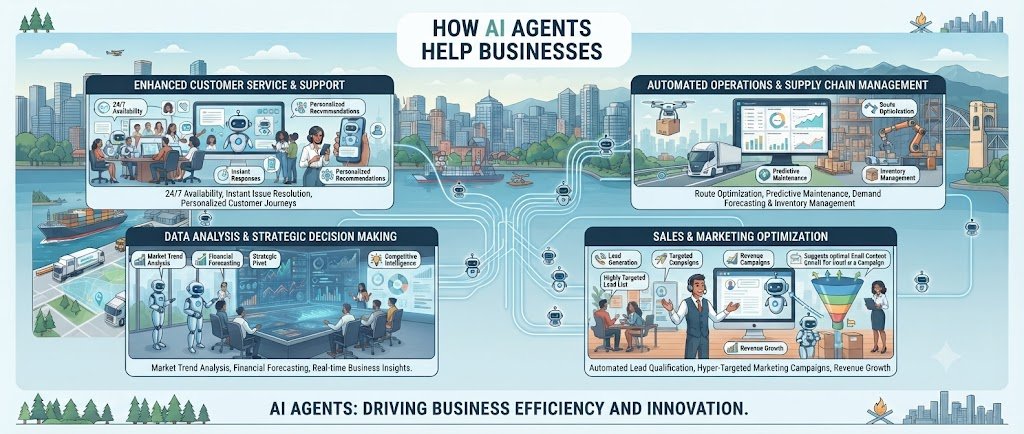
If you run a business in Vancouver, you’ve probably heard the term “AI agent” thrown around a lot this year — in networking groups, on LinkedIn, maybe even from a competitor who suddenly seems to respond to customers faster than you do. So the real question business owners are asking isn’t “what is AI” anymore. It’s more practical than that: how can AI agents help businesses actually operate better, day to day, without adding more complexity to an already busy schedule? The short answer is that AI agents take over repetitive, time-consuming tasks — answering customer questions, qualifying leads, organizing data, following up on emails — so your team can focus on the parts of the business that genuinely need a human touch. But the longer answer depends on what your business looks like, what’s slowing you down right now, and how ready you are to bring automation into your existing systems. This guide walks through that in plain language, without the hype. What Exactly Is an AI Agent, and How Is It Different From a Chatbot? A lot of people use “AI agent” and “chatbot” interchangeably, but they’re not quite the same thing. A basic chatbot follows a script. It waits for a keyword or a button click and responds with a pre-written answer. If a customer asks something outside that script, the chatbot usually stalls or hands the conversation off to a human. An AI agent works differently. It understands context, remembers earlier parts of a conversation, and can take action — booking an appointment, updating a CRM record, or pulling information from a database — instead of just replying with text. Some AI agents can even complete multi-step tasks on their own, like checking inventory before confirming an order, or flagging a support ticket that needs urgent attention. That distinction matters because it’s the reason AI agents can handle far more than simple Q&A. It’s also why so many businesses are now looking at AI agents as a genuine operational tool rather than a novelty feature on their website. How Can AI Agents Help Businesses Improve Customer Service? This is usually where businesses see the most immediate difference. Customers don’t like waiting, and in a competitive market like Vancouver, a slow response can quietly cost you a sale you never even hear about. AI agents can: Answer common questions instantly, at any hour, without a customer feeling like they’re talking to a wall Pull up order history or account details so the response is actually relevant, not generic Escalate complex issues to a human agent with full context already attached, so the customer doesn’t have to repeat themselves Handle multiple conversations at once, which is something no single support rep can do The goal isn’t to remove people from customer service. It’s to make sure your team spends their time on the conversations that actually need judgment and empathy, while the AI agent handles the routine questions that make up most support volume. How Can AI Agents Help Businesses Boost Sales and Marketing? Sales teams often lose momentum in the gap between “interested lead” and “actual follow-up.” That gap is usually where AI agents earn their keep. An AI agent can qualify leads based on the questions they ask or the pages they visit, then route the promising ones straight to a sales rep instead of letting them sit in a generic inbox. On the marketing side, agents can personalize email sequences, segment audiences based on behavior, and even draft first versions of ad copy or product descriptions for a human to review and refine. None of this replaces a good salesperson. What it does is remove the guesswork about who to call first and reduce the number of leads that quietly go cold because nobody got back to them in time. How Can AI Agents Help Businesses With CRM and Data Analysis? Most businesses have more customer data than they actually use. It sits in spreadsheets, old email threads, and half-updated CRM fields — technically there, but not doing anything useful. AI agents can clean up that mess by automatically logging interactions, updating contact records, and spotting patterns a busy team might miss — like a customer who’s gone quiet after months of regular orders, or a product that keeps coming up in support complaints. Instead of running a manual report every quarter, you get insights closer to real time, which makes it easier to act before a small issue becomes a bigger one. This is one of the areas where the value compounds. A CRM that updates itself accurately is worth far more than one that requires constant manual entry nobody has time for. How Can AI Agents Help Businesses Automate Everyday Workflows? Beyond customer-facing tasks, AI agents are quietly good at the internal, administrative work that eats up hours without anyone noticing. Think about scheduling, invoice follow-ups, inventory alerts, or routing internal requests to the right department. These aren’t glamorous tasks, but they’re the ones that pile up and create bottlenecks when a team is small or stretched thin — which describes a lot of Vancouver’s small and mid-sized businesses. Workflow automation through AI agents doesn’t mean replacing your operations team. It means giving them fewer manual steps to babysit, so the business runs smoothly even on a busy Friday afternoon when everyone’s stretched thin. What Should Vancouver Business Owners Know About AI Integration and Security? This is the part that deserves honest attention, not just a reassuring line at the end of a sales pitch. Integrating AI agents into an existing business means connecting them to systems that already hold sensitive information — customer records, payment details, internal communications. That connection needs to be handled carefully, with clear permissions about what the AI agent can access and what it can’t. Is Customer Data Safe When Using AI Agents? It can be, but only if the implementation is done properly. Businesses should ask their AI provider specific questions: Where is the data stored?