
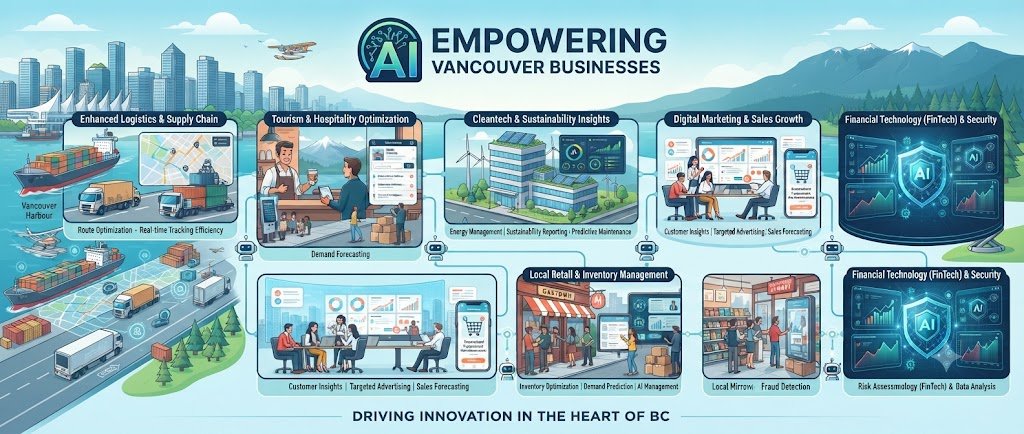
If you run a business in Vancouver, you’ve probably asked yourself this question while watching a competitor respond to customer emails faster than you can, or while wondering why your team spends half the week on spreadsheets that should take minutes. How can AI help Vancouver businesses? In short: it takes over the repetitive, time-consuming work — customer replies, data entry, follow-ups, scheduling, reporting — so your team can spend their energy on the things that actually grow the business. This isn’t about replacing people or chasing hype. It’s about giving a local bakery, a law office in Gastown, a moving company in Burnaby, or a growing tech startup on Granville Street a practical way to do more with the staff and budget they already have. Below, we’ll walk through exactly where AI fits into a Vancouver business, what it costs to get started, and what to watch out for. What Does “AI for Business” Actually Mean? When people ask how can AI help Vancouver businesses, they’re usually picturing something complicated — robots, code, a six-figure IT project. In practice, it’s much simpler. Business AI today mainly falls into a few categories: Conversational AI — chatbots and virtual assistants that answer customer questions on your website or social channels, day or night. Automation — software that handles repetitive tasks like invoice processing, appointment reminders, or lead follow-up without a person clicking through each step. Data and analytics — tools that sort through sales, customer, or website data and flag patterns a person might miss. Content and marketing support — AI-assisted writing, personalization, and campaign optimization. Most Vancouver businesses don’t need all four at once. The right starting point depends on where your time is actually going. Why Are So Many Vancouver Businesses Turning to AI Right Now? Vancouver’s business costs — commercial rent, wages, and general overhead — are among the highest in Canada. That pressure is exactly why AI has moved from “nice to have” to a real consideration for small and mid-sized companies here. When you can’t easily hire another full-time employee, automating three or four hours of manual work a week starts to matter. There’s also a national push behind this shift. Innovation, Science and Economic Development Canada (ISED) has published guidance recognizing that adopting AI can boost productivity, unlock innovation, and support economic growth for small and medium-sized businesses, while also acknowledging that smaller companies often face real barriers to adoption — cost, complexity, and limited in-house expertise chief among them. That’s a fair summary of what most Vancouver business owners are navigating: the potential is real, but so is the learning curve. ISED Canada How Can AI Help Vancouver Businesses With Customer Service? This is usually the first place people look, and for good reason. A simple AI chatbot on your website can: Answer common questions (hours, pricing, availability, order status) instantly Capture a lead’s contact details when your team isn’t online Route more complex questions straight to a human, with context already gathered A Vancouver moving company, for example, might use a chatbot to answer “do you service North Vancouver?” or “what’s your minimum for a studio move?” at 9 p.m. on a Sunday — capturing the booking instead of losing it to a competitor who answers first thing Monday. How Can AI Help Vancouver Businesses Save Time on Daily Tasks? Automation is where the time savings really add up. Instead of a person manually re-entering customer details between your booking system and your CRM, or sending the same follow-up email one contact at a time, automation tools can do it in the background. Common examples for local businesses include: Auto-generating invoices once a job is marked complete Sending appointment reminders without manual scheduling Syncing new leads from your website directly into your CRM Flagging overdue follow-ups so nothing falls through the cracks None of this requires rebuilding your systems from scratch — most of it connects to tools you’re already using. How Can AI Help Vancouver Businesses Improve Sales and Marketing? AI doesn’t write your marketing strategy for you, but it does make execution faster. Practical, realistic uses include: Personalizing email campaigns based on what a customer previously bought or browsed Scoring leads so your sales team calls the most promising ones first Drafting first versions of ad copy or product descriptions for a human to refine Analyzing which pages or offers are actually converting visitors into customers For a Vancouver retailer or service business competing with national chains, this kind of targeting can matter more than a bigger ad budget. How Can AI Help Vancouver Businesses Make Sense of Their Data? Most small businesses are sitting on more useful data than they realize — sales trends, website traffic, customer feedback — but don’t have time to dig through it. AI-powered analytics tools can summarize that data into plain-language insights: which products sell best by season, which marketing channel brings in the most repeat customers, or where customers tend to drop off before completing a purchase. The value isn’t the technology itself; it’s the decisions it lets you make faster. What Should a Vancouver Business Know About AI Privacy and Security? This is a fair question to ask before adopting anything. A few practical points: Know where your data is stored. Some AI tools process data outside Canada, which matters if you handle sensitive customer information. Check vendor security practices. Ask how customer data is encrypted, stored, and who has access to it. Start with lower-risk use cases. Customer FAQs and internal automation carry far less risk than tools handling financial or health information. Review contracts carefully, especially around data ownership and retention. The federal government’s own resources on AI procurement reflect this same caution — Canada maintains a public list of AI suppliers recognized for responsible and effective AI services, which, while built for public-sector buying, is a useful reference point for any Vancouver business vetting an AI vendor. ISED Canada How Much Does AI Implementation Cost for a Vancouver Business?
What Are the Best AI Solutions for Vancouver Businesses?
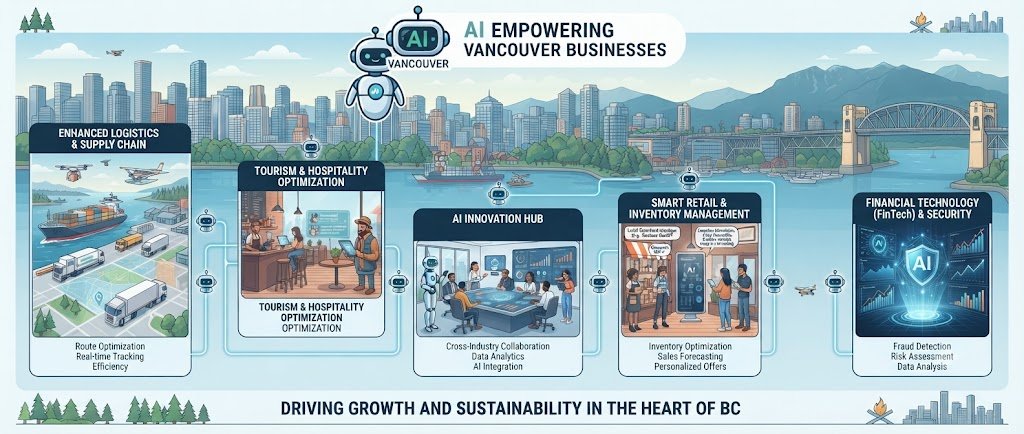
If you’ve been searching for what are the best AI solutions for Vancouver businesses, you’ve probably noticed most answers online are either too technical or too vague to actually act on. This page is meant to fix that. We’ll walk through the practical side of AI — what it actually does, what it costs, what risks to watch for, and how Vancouver companies are using it in ways that make sense for their size and industry. At Global Tech Mind, we work directly with Vancouver business owners to plan and build these systems, so this guide reflects what we see come up in real conversations, not theoretical use cases. What Are the Best AI Solutions for Vancouver Businesses Right Now? The short answer: it depends on what’s eating up your time. For most Vancouver businesses, the highest-impact starting points are AI-powered customer service tools, workflow automation, and data analysis — because these three areas tend to carry the most repetitive, manual work. Rather than adopting AI because it’s trending, the businesses that see real value start by identifying a specific bottleneck — slow response times, manual data entry, inconsistent follow-ups — and apply AI to that one problem first. Why Are Vancouver Businesses Investing in AI Right Now? Vancouver’s cost of doing business — rent, wages, and competition across retail, real estate, hospitality, and professional services — has pushed many owners to look for ways to do more without simply hiring more people. AI fits that need well because it handles volume and repetition without getting tired or making the same small errors humans do after hour eight of a shift. It’s also worth noting that adoption isn’t just a local trend. The Government of Canada has actively supported responsible AI development through national initiatives, including its ongoing work through the AI Strategy Task Force, which signals a broader push toward practical, well-governed AI use across Canadian industries. How Can AI Improve Customer Service for Vancouver Businesses? AI chatbots and virtual assistants can answer common customer questions instantly, at any hour, without making your customers wait for business hours. For a Vancouver café chain or a local law firm, this might mean handling booking requests, answering FAQs, or routing urgent issues to a real person immediately. The key is training these tools on your actual business information — not generic scripts — so responses feel accurate and specific rather than robotic. Can AI Help With Sales and Marketing for Local Businesses? Yes, and this is often where businesses see the clearest return. AI tools can: Score and prioritize leads based on how likely they are to convert Personalize email and ad content based on customer behaviour Predict which products or services a customer is likely to need next For example, a Vancouver retailer might use AI to identify which past customers are most likely to respond to a re-engagement email, instead of sending the same message to an entire list. How Does AI Work With CRM Systems? Most modern CRM platforms already support AI features like lead scoring, automated follow-up reminders, and predictive deal forecasting. If you’re already using a CRM, adding AI capabilities is often less disruptive than starting from scratch — it builds on data you’re already collecting. This is one reason CRM-integrated AI is a common early step for service-based Vancouver businesses like real estate agencies, consultancies, and clinics. What Is Workflow Automation and Does My Business Need It? Workflow automation uses AI and rule-based logic to handle repetitive tasks — things like invoice generation, appointment scheduling, inventory updates, or internal approvals — without manual input at every step. You likely need it if your team regularly does the same task multiple times a day with little variation. That’s usually a strong signal the process can be automated safely and accurately. How Does AI Help With Data Analysis for Small and Mid-Sized Businesses? AI can process sales, customer, and operational data far faster than manual spreadsheet review, surfacing patterns that are easy to miss otherwise — like seasonal demand shifts or underperforming service lines. For Vancouver businesses managing multiple locations or high transaction volumes, this often means fewer surprises and better planning. Is AI Integration Difficult for an Existing Business? Not necessarily, but it depends on your current systems. Integration is usually straightforward when your existing software has open APIs or built-in AI features. It becomes more involved if you’re working with older, custom-built systems that need additional development work to connect properly. A short technical assessment upfront typically clarifies this before any commitment is made. Is AI Safe for Customer Data and Privacy? This is one of the most important questions to ask before adopting any AI tool, and it deserves a direct answer: AI is only as safe as the systems and policies around it. Reputable providers should be transparent about where your data is stored, how it’s used, and whether it’s shared with third parties. Canadian businesses are also expected to comply with existing privacy regulations, including PIPEDA, when handling customer data through any automated system. Choosing AI vendors who understand and design around these requirements matters more than the AI features themselves. How Much Do AI Solutions Cost for Vancouver Businesses? Costs vary widely depending on scope. A single chatbot or basic automation tool is typically far less expensive than a custom-built AI system integrated across multiple platforms. Most businesses start with one focused solution, measure the impact, and expand from there rather than committing to a large system upfront. How Long Does It Take to See ROI From AI? This depends on the use case, but time-saving tools like automation and chatbots often show measurable impact within the first few weeks, since they directly reduce manual hours. More complex systems, like predictive analytics, may take longer to show clear ROI because they rely on data accumulating over time. What Are the Best AI Solutions for Vancouver Businesses That Are Just Getting Started? If you’re new to this, the best AI solutions
10 Proven Web Promotion Strategies to Increase Website Traffic
Your website is live, it looks good, and still… barely anyone visits it. Sound familiar? Here are 10 proven web promotion strategies to increase website traffic that actually work for small businesses across Canada, whether you run a shop in Toronto, a clinic in Calgary, or an online store shipping across Ontario. No fluff, no guesswork. Just clear steps: publish content built around search intent, fix your on-page basics, get listed on Google Business Profile, build local backlinks, use email lists, post consistently on social media, speed up your site, target long-tail keywords, run small local ads, and track your results monthly. Do these one at a time, and traffic grows steadily, not overnight, but for real. At GlobalTechMind, we work with Canadian business owners every week who feel stuck at this exact spot. So let’s break this down the way we would over coffee, not a boardroom table. What Are the Best Web Promotion Strategies to Increase Website Traffic? Honestly, there is no single trick. Growth comes from stacking small wins. The strongest web promotion strategies to increase website traffic combine search visibility, local trust signals, and content people actually search for. Think of it like planting a garden. One seed won’t feed you. A few rows, watered weekly, will. Below, we walk through each strategy in plain language, plus a step process you can follow this week. Why Is My Website Not Getting Traffic Even With Good Content? This one hurts to hear, but it needs saying. Good content alone does not bring visitors. Google cannot recommend a page it cannot understand or trust yet. If your site is new, has weak internal structure, or is missing basic technical fixes, even great writing sits invisible on page 5. We get it. You spent hours on that blog post. You checked it for typos. You hit publish, and… nothing. That silence is discouraging, and it is not your fault. Here is the fix. Start with your on-page seo, because this is the foundation search engines actually read. Clean titles, clear headings, fast loading pages, and proper internal linking tell Google your site is worth showing. Once that foundation is solid, your content finally gets a fair shot at ranking. How Can Small Businesses in Canada Boost Website Traffic Without a Big Budget? Big budgets help, sure. But they are not required. Many Canadian small businesses grow traffic using free or low-cost methods first. Claim and complete your Google Business Profile with your real city and service area. Answer real customer questions in blog posts, using the exact words people type into search. Ask happy customers for short, honest reviews. Share your content in local Facebook groups and community pages. Build a simple email list and message it monthly. These small actions, repeated weekly, add up faster than most owners expect. This is one of the most overlooked web promotion strategies to increase website traffic, because it costs almost nothing but consistent effort. You’re Posting Content But Rankings Aren’t Moving We hear this constantly. “I post twice a week. Why is nothing happening?” It is frustrating to put in effort and see flat numbers on your analytics dashboard. Here is what is usually going on. Posting without a plan is like shouting into a crowded room. Google needs a reason to trust your site as an authority, not just an active one. That trust builds through a proper seo strategy, one that maps content to real search intent, links pages together with purpose, and targets keywords your actual customers use, not just industry jargon. The solution is not posting more. It is posting smarter, with structure behind it. Your Website Traffic Comes From the Wrong Visitors Another common problem. Traffic shows up in your analytics, but nobody buys, calls, or emails. That is because broad, generic keywords bring broad, generic visitors, people who were never looking for what you sell. The fix is targeting specific, local, intent-based phrases. Instead of “plumber,” try “emergency plumber near Mississauga open weekends.” Instead of “bakery,” try “custom birthday cakes Vancouver same day pickup.” These longer phrases attract fewer visitors, but far more of them convert. This shift alone is one of the most effective web promotion strategies to increase website traffic that actually turns into paying customers. A Simple Step Process to Start Web Promotion This Week You do not need to do everything at once. Follow this order. Audit your site basics. Check page speed, mobile view, and broken links. Fix on-page seo. Titles, headers, meta descriptions, image alt text. Pick 5 to 10 keywords real customers would search, including your city name. Write one helpful page per keyword, answering the question directly. Set up and complete Google Business Profile with correct hours and location. Build a few honest local backlinks through partnerships or directories. Share every new page on social media and to your email list. Check results monthly and adjust what is not working. This is the core sequence behind most working web promotion strategies to increase website traffic, and it does not require a technical background to start. Why Should Canadian Families and Small Businesses Trust GlobalTechMind? We are a Canadian based team, and we are creating websites and marketing plans based on the Canadian search habits, seasons and customer expectations. We adhere to the recommendations of trusted national sources such as the Canadian government’s own Canada Digital Adoption Program that is helping small businesses develop a stronger online presence throughout the country. We also believe in protecting families – not just getting clicks. It means no fake promises of ranking, no misleading advice that will make it look easier to rank higher, and content that is created for the people who are searching, not for the algorithm. If your foundation needs attention first, we can examine your on page seo setup and if you’d like a complete roadmap created based on your goals, our seo strategy planning takes you through it step by step. Conclusion Increasing website traffic

How to Build an AI Voice Agent for Healthcare: In Depth Guide
How to Build an AI Voice Agent for Healthcare: In Depth Guide March 16, 2026 Healthcare organizations are under pressure like never before. Call volumes are rising. Patients expect instant responses. Front-desk teams are overloaded with patient calls. And missed calls often mean lost revenue. What if every patient call was answered instantly, 24/7, without increasing staffing costs? An AI voice agent for healthcare makes that possible. Think of it as a digital front-desk executive that never sleeps and do all tasks through natural, human-like conversations, including: Schedule appointments Handle rescheduling Send reminders Answer common queries Manage follow-ups Intelligently route urgent cases In a competitive healthcare market expected to expand to USD 747.70 billion by 2030, growing at a CAGR of 10.21% from 2025 to 2030, patient experience starts with the first call. And increasingly, that first interaction is powered by AI. What is an AI Voice Agent Development for Healthcare? We build an AI voice agent for healthcare that allows hospitals, clinics, telehealth providers & diagnostic centers to automate patient communication through intelligent voice conversations. The AI voice agent empowers healthcare organizations to: Answer inbound patient calls instantly Provide lab report status updates Send medication & appointment reminders Route emergency or priority calls appropriately Handle insurance verification and basic FAQs Conduct post-visit follow-ups and feedback collection Book, reschedule & cancel appointments automatically Manage high call volumes during vaccination drives or seasonal peaks Build your own Healthcare AI Voice Agent to streamline operational burden, improving patient satisfaction, preventing revenue leakage from missed calls, and so on. Types of AI Voice Agents: 1. Rule-Based Voice Agents (Basic Level): These are the predefined scripts & decision trees that respond to queries in X → Y format. For example, a system asks to press 1 for an appointment, press 2 for billing, etc. These are unable to handle unexpected questions well. 2. Conversational AI Voice Agents (NLP-Powered): Embedded with natural language processing, these understand natural speech using AI. For instance, instead of pressing numbers, patients can simply say, “I need to reschedule my dentist appointment.” The system understands intent and responds naturally. 3. AI Voice Assistants (Multi-Purpose Agents): These are advanced agents that handle multiple tasks across departments, such as sending reminders, transferring calls, scheduling appointments, etc. These agents easily integrate with CRM platforms, ERP & EHR systems. Suitable for enterprise-level. 4. Task-Focused Voice Agents: AI voice agent development for healthcare is specific to workflows. For example, an appointment-scheduling or prescription-refill agent. These are optimized for a single job & do it extremely well, such as automating for a specific department. 5. AI Voice Agents with Human Handoff: These agents manage conversations, plus smoothly transfer complex cases to humans. For instance, if a patient mentions chest pain, the system escalates immediately. These hybrid agents are commonly used in healthcare. 6. Autonomous AI Voice Agents (Advanced Level): These are next-generation systems that think contextually, handle complex workflows, personalize responses & leverage contextually relevant information. These agents use large language models, along with advanced reasoning, to generate responses that parallel patient queries. 7. Outbound AI Voice Agents: Instead of answering calls, these voice AI agents make calls automatically. These help manage appointment reminders, follow-up calls, as well as payment reminders. Healthcare voice automation solutions are highly effective at reducing no-shows. FAQS What is an AI voice agent in healthcare? An AI voice agent is an intelligent virtual assistant that uses artificial intelligence, natural language processing (NLP), and speech recognition to communicate with patients through voice. It can automate appointment scheduling, answer common healthcare questions, send medication reminders, verify insurance information, and provide 24/7 patient support while reducing the workload on healthcare staff. How can AI voice agents improve patient care? AI voice agents enhance patient care by providing instant responses, reducing wait times, automating routine administrative tasks, and offering personalized interactions. They can assist with appointment booking, follow-up calls, symptom screening, prescription refill reminders, and multilingual support, allowing healthcare professionals to focus more on patient treatment and critical care. Is an AI voice agent secure and HIPAA-compliant? Yes, an AI voice agent can be designed to meet HIPAA and other healthcare data privacy regulations. By implementing end-to-end encryption, secure authentication, role-based access controls, audit logs, and compliant cloud infrastructure, healthcare organizations can protect sensitive patient information while ensuring safe and reliable voice interactions.

Polymarket Clone – White-Label Prediction Market Platform
A Polymarket clone script is the fastest, most cost-effective path to launching your own decentralized prediction market platform, without 6 to 12 months of custom development. Decentralized prediction markets are quickly turning into a mainstream financial technology. They allow traders to place bets on the outcome of real-world events such as politics, sports, and economic data using blockchain-based smart contracts. The timing is ideal. Institutional interest in prediction markets has moved from theoretical to active, regulatory barriers in key markets are being dismantled, and real on-chain liquidity now exists at scale. For crypto exchanges, Web3 startups, and fintech businesses, the gap in the market is not demand it is well-built, trustworthy platforms. Our Polymarket clone script gives you the infrastructure to fill that gap, with a fully audited, white-label solution that can be customized, branded, and deployed in weeks. What is a Polymarket Clone Script? A Polymarket clone script is a ready-to-deploy software solution that replicates Polymarket’s core architecture enabling businesses to launch a fully functional decentralized prediction market without building from scratch. It includes the complete technical stack required to operate at scale: The solution supports automated market creation, dynamic odds calculation, cryptocurrency-based trading, and transparent on-chain settlement — across a wide range of real-world event categories including politics, crypto, finance, sports, and entertainment. With full white-label customization, businesses can deploy a fully branded platform aligned with their specific business model and target audience. Polymarket Platform — Key Statistics Before building a Polymarket-style platform, understanding the benchmark you’re competing with is essential. Here are the key figures that define the Polymarket platform: Feature Polymarket Platform Details Platform Type Decentralized, blockchain-based prediction market enabling global event trading. Market Settlement Instant settlement after event resolution through smart contract execution. Withdrawal Speed Typically processed within minutes depending on network confirmation. Mobile Accessibility Dedicated mobile applications available for both iOS and Android devices. 7-Day Market Volume Approximately $1.7 billion in trading activity across prediction markets. Liquidity High liquidity across trending and major event markets. Trading Fees Around 0.01% (1 basis point) based on total contract premium on US platform. Core Advantage Transparent on-chain trading powered by blockchain infrastructure and automated settlement. How a Polymarket-Style Prediction Market Platform Works A Polymarket-style platform operates on blockchain-based smart contracts and real-world data feeds, allowing users to trade on the outcomes of future events. Every market is transparent, automated, and trustless eliminating the need for a central authority. 1. Event Market Creation Platform administrators or approved market creators establish prediction markets with clearly defined binary (Yes/No) or multi-outcome events. Each market is deployed as an independent smart contract on the blockchain, embedding: This smart contract architecture ensures transparent rules, immutable market conditions, and predetermined settlement logic that cannot be altered after deployment. 2. Outcome Tokens & Pricing For each possible event outcome, the system mints corresponding outcome tokens (e.g., “YES” and “NO” tokens for binary markets). The market price of these tokens represents the implied probability of that outcome occurring, as determined by collective market sentiment. Example: If YES tokens trade at $0.65, the market implies a 65% probability of that outcome. Price Discovery As users buy or sell outcome tokens, prices adjust dynamically through the AMM algorithm based on: 3. Automated Market Maker (AMM) The AMM serves as the algorithmic liquidity provider and price discovery mechanism, replacing traditional order book systems. Core AMM Functions: 4. User Trading & Liquidity Users connect their crypto wallets, fund their accounts, and trade outcome tokens. Liquidity pools support continuous trading, while smart contracts securely handle all transactions. Trading Workflow Liquidity Provision Liquidity providers (LPs) deposit capital into market pools and earn: All transactions are executed through smart contracts, ensuring secure, transparent, and non-custodial trading. 5. Oracle-Based Event Resolution When an event concludes, the platform must determine the correct outcome through decentralized oracle networks that provide verifiable real-world data. Oracle Resolution Process: Oracle Security Measures: 6. On-Chain Settlement & Payouts Settlement Mechanism Upon oracle confirmation of the event outcome:

Polymarket Copy Trading Bot Development Company
Polymarket processes over $1 billion in monthly trading volume, making it the world’s largest decentralized prediction market by a significant margin. For developers, fintech platforms, and DeFi protocols looking to participate programmatically, Polymarket copy trading bot development is the most direct path to systematic, automated exposure to this market. A Polymarket copy trading bot is an automated system that monitors the on-chain activity of high-performing wallets and replicates their trades in real time on your behalf. Unlike generic trading bots, a purpose-built Polymarket automation solution must natively support the CLOB (Central Limit Order Book) infrastructure on which Polymarket operates — handling conditional token markets, real-time WebSocket price feeds, liquidity routing, order-matching engine interaction, and Polygon RPC node connectivity for low-latency settlement. Our development team builds production-grade Polymarket bot infrastructure for DeFi protocols, hedge funds exploring prediction market exposure, Web3 startups, and fintech platforms requiring institutional-quality execution logic. Why Fintech Platforms Are Investing in Polymarket Bot Development The prediction market sector exceeded $46 billion in trading volume in 2025 and continues to grow. Prediction markets demonstrate 10–20% higher forecasting accuracy than traditional polling methods which is why organizations are deploying bots to analyze signals, replicate strategies, and execute trades at machine speed. Rising Popularity of Prediction Markets Platforms like Polymarket and Kalshi have proven that real-money forecasting markets generate deep liquidity and high engagement at scale. Demand for Automated Trading Users increasingly prefer automated trading solutions that reduce manual decision-making and enable faster trade execution. Competitive Advantage First-movers deploying automated prediction market infrastructure are capturing market share before this space becomes crowded. Strategy Replication Capabilities Copy trading bots allow platforms to productize expert trader performance and offer it as a service to users who lack the time or skill to trade independently. Better Risk Management Automated bots enforce predefined position limits and exposure thresholds consistently something manual traders cannot match under pressure. How a Polymarket Copy Trading Bot Works A Polymarket copy trading bot operates through a four-stage automated pipeline that runs continuously without manual intervention: Wallet Activity Monitoring The bot continuously tracks on-chain wallet activity of selected traders to detect new trade signals. Trade Signal Processing Once a trade is detected, the system processes market data and validates the signal before replicating it. Automated Trade Execution The bot executes the trade automatically on the Polymarket CLOB infrastructure with predefined risk controls in place. Portfolio Tracking The system maintains real-time portfolio updates and performance analytics for the copied trades. Build a Production-Ready Polymarket Trading Bot CLOB-native infrastructure with real-time WebSocket execution, multi-wallet tracking, and built-in risk controls — not a prototype.Talk to Our Engineers Our Polymarket Copy Trading Bot Development Services We offer end-to-end Polymarket copy trading bot development and automation services from custom bot architecture and smart contract integration to full-scale copy trading platform builds. Custom Polymarket Copy Trading Bot We build fully customized copy trading bots that automate trade replication from expert wallets. Each bot is configured for real-time trade detection, conditional token handling, risk-controlled execution, and scalable deployment within the Polymarket CLOB ecosystem. Polymarket Trading Bot Development We develop automated trading bot frameworks for Polymarket covering real-time market monitoring, prediction outcome analysis, multi-market execution, and strategy-based order placement. Bots are built to handle the CLOB order model natively, not adapted from generic exchange bots. Polymarket Copy Trading Platform For businesses building user-facing products, we develop full-scale copy trading platforms with trader discovery, capital allocation controls, multi-wallet replication, and performance analytics. We also offer Polymarket clone development for teams launching customized prediction market platforms. Wallet Monitoring and Trade Signal Detection Our systems monitor on-chain wallet activity of selected traders to detect trade signals in real time and trigger automated replication based on predefined execution rules. Automated Trade Execution Engine We build high-performance execution engines with three-phase order logic progressive price adjustment and intelligent retry fallback, maximizing fill probability even in low-liquidity conditions. Risk Management and Exposure Controls Every bot includes position size limits, per-market trade caps, session-level notional exposure limits, and balance verification before each order. Risk rules are enforced at the code level not optional settings. Core Capabilities of Our Polymarket Copy Trading Bot Explore the features we built into our Polymarket copy trading bot to automate trades, track performance, and optimize risk management for seamless copy trading experiences. Automated Trade Replication The bot replicates trades based on configurable parameters: copy ratio (0.1x to 1x), minimum trigger amounts, maximum position size, and market-type filters. Replication logic handles both BUY and SELL orders with configurable sell handling (proportional, fixed, or percentage-based). Real-Time Market Data Processing The bot processes market data continuously through Polymarket’s REST API and WebSocket streams. This real-time pipeline enables copy trade execution with sub-second latency, reducing the risk of copying stale or already-moved positions. Portfolio Allocation Controls Users allocate capital across multiple traders or markets using predefined allocation parameters. The system enforces per-trader limits, per-market exposure caps, and portfolio balance thresholds maintaining diversification automatically. Performance Tracking Dashboard A real-time analytics dashboard surfaces key metrics per copied trader: profitability, win rate, trade volume, and position history. Users compare trader performance side by side and adjust allocation weights based on live data.ults. Multi-Trader Copying The bot supports simultaneous replication from multiple target wallets, enabling diversification across trading styles, market categories, and risk profiles. This is how serious automated participants manage strategy concentration risk. Smart Contract Integration Trade replication occurs through verified smart contract interactions on Polygon. All USDC.e settlement, CLOB contract approvals, and position management are handled programmatically, no manual intervention or custodial dependency. Types of Polymarket Automation Tools and Trading Strategies There are different types of Polymarket trading bots designed for prediction markets, similar to automation systems used in crypto trading bot development for digital asset trading. API-Driven Trading Bots These trading bots interact directly with the Polymarket API to retrieve market data and place trades on the platform. Advanced versions of these bots can use additional analytics, such as probabilities and sentiment. Copy Trading Bots This type of trading bot copies trades from expert wallets on the Polymarket platform. This type of