If you run a business in Vancouver, you’ve probably heard the term “AI agent” thrown around a lot this year — in networking groups, on LinkedIn, maybe even from a competitor who suddenly seems to respond to customers faster than you do. So the real question business owners are asking isn’t “what is AI” anymore. It’s more practical than that: how can AI agents help businesses actually operate better, day to day, without adding more complexity to an already busy schedule?
The short answer is that AI agents take over repetitive, time-consuming tasks — answering customer questions, qualifying leads, organizing data, following up on emails — so your team can focus on the parts of the business that genuinely need a human touch. But the longer answer depends on what your business looks like, what’s slowing you down right now, and how ready you are to bring automation into your existing systems.
This guide walks through that in plain language, without the hype.
What Exactly Is an AI Agent, and How Is It Different From a Chatbot?
A lot of people use “AI agent” and “chatbot” interchangeably, but they’re not quite the same thing.
A basic chatbot follows a script. It waits for a keyword or a button click and responds with a pre-written answer. If a customer asks something outside that script, the chatbot usually stalls or hands the conversation off to a human.
An AI agent works differently. It understands context, remembers earlier parts of a conversation, and can take action — booking an appointment, updating a CRM record, or pulling information from a database — instead of just replying with text. Some AI agents can even complete multi-step tasks on their own, like checking inventory before confirming an order, or flagging a support ticket that needs urgent attention.
That distinction matters because it’s the reason AI agents can handle far more than simple Q&A. It’s also why so many businesses are now looking at AI agents as a genuine operational tool rather than a novelty feature on their website.
How Can AI Agents Help Businesses Improve Customer Service?
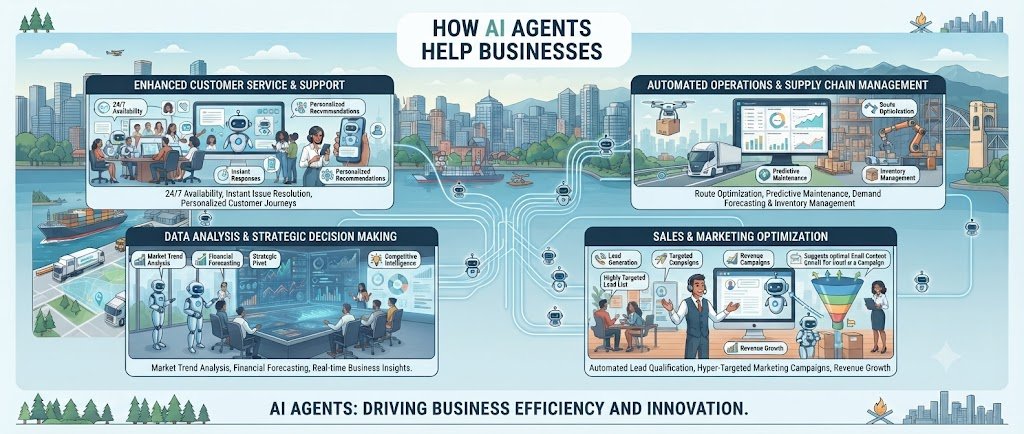
This is usually where businesses see the most immediate difference. Customers don’t like waiting, and in a competitive market like Vancouver, a slow response can quietly cost you a sale you never even hear about.
AI agents can:
- Answer common questions instantly, at any hour, without a customer feeling like they’re talking to a wall
- Pull up order history or account details so the response is actually relevant, not generic
- Escalate complex issues to a human agent with full context already attached, so the customer doesn’t have to repeat themselves
- Handle multiple conversations at once, which is something no single support rep can do
The goal isn’t to remove people from customer service. It’s to make sure your team spends their time on the conversations that actually need judgment and empathy, while the AI agent handles the routine questions that make up most support volume.
How Can AI Agents Help Businesses Boost Sales and Marketing?
Sales teams often lose momentum in the gap between “interested lead” and “actual follow-up.” That gap is usually where AI agents earn their keep.
An AI agent can qualify leads based on the questions they ask or the pages they visit, then route the promising ones straight to a sales rep instead of letting them sit in a generic inbox. On the marketing side, agents can personalize email sequences, segment audiences based on behavior, and even draft first versions of ad copy or product descriptions for a human to review and refine.
None of this replaces a good salesperson. What it does is remove the guesswork about who to call first and reduce the number of leads that quietly go cold because nobody got back to them in time.
How Can AI Agents Help Businesses With CRM and Data Analysis?
Most businesses have more customer data than they actually use. It sits in spreadsheets, old email threads, and half-updated CRM fields — technically there, but not doing anything useful.
AI agents can clean up that mess by automatically logging interactions, updating contact records, and spotting patterns a busy team might miss — like a customer who’s gone quiet after months of regular orders, or a product that keeps coming up in support complaints. Instead of running a manual report every quarter, you get insights closer to real time, which makes it easier to act before a small issue becomes a bigger one.
This is one of the areas where the value compounds. A CRM that updates itself accurately is worth far more than one that requires constant manual entry nobody has time for.
How Can AI Agents Help Businesses Automate Everyday Workflows?
Beyond customer-facing tasks, AI agents are quietly good at the internal, administrative work that eats up hours without anyone noticing.
Think about scheduling, invoice follow-ups, inventory alerts, or routing internal requests to the right department. These aren’t glamorous tasks, but they’re the ones that pile up and create bottlenecks when a team is small or stretched thin — which describes a lot of Vancouver’s small and mid-sized businesses.
Workflow automation through AI agents doesn’t mean replacing your operations team. It means giving them fewer manual steps to babysit, so the business runs smoothly even on a busy Friday afternoon when everyone’s stretched thin.
What Should Vancouver Business Owners Know About AI Integration and Security?
This is the part that deserves honest attention, not just a reassuring line at the end of a sales pitch.
Integrating AI agents into an existing business means connecting them to systems that already hold sensitive information — customer records, payment details, internal communications. That connection needs to be handled carefully, with clear permissions about what the AI agent can access and what it can’t.
Is Customer Data Safe When Using AI Agents?
It can be, but only if the implementation is done properly. Businesses should ask their AI provider specific questions: Where is the data stored? Who has access to it? Is it encrypted? Does the system comply with Canadian privacy standards? The Office of the Privacy Commissioner of Canada publishes clear guidance on how businesses should handle personal information responsibly, and it’s worth reviewing before rolling out any AI tool that touches customer data.
A reputable AI implementation partner will walk you through these questions before you ever go live, not after something goes wrong.
How Much Does It Cost to Implement AI Agents, and What’s the ROI?
Costs vary quite a bit depending on complexity. A simple customer service agent handling FAQs is a much smaller project than a fully integrated system connected to your CRM, inventory, and marketing platforms. Some businesses start small — automating one workflow — and expand once they see how it fits into daily operations.
As for return on investment, it’s rarely instant, and anyone who promises otherwise probably isn’t being fully honest with you. The real payoff tends to show up gradually: fewer missed leads, less time spent on repetitive admin work, faster customer response times, and a support team that isn’t constantly buried. Those savings add up, but they’re easier to measure a few months in than in the first week.
If you’re weighing this decision, it helps to talk it through with a team that can look at your specific setup rather than sell you a one-size-fits-all package. Global Tech Mind’s AI solutions Vancouver team works directly with local businesses to figure out where automation actually makes sense before recommending anything.
How Do You Know If Your Business Is Ready for AI Agents?
You don’t need to be a large company or have a dedicated IT department to get started. What you do need is clarity about where your time is actually going. If your team spends hours answering the same customer questions, chasing follow-ups, or manually updating records, that’s usually a good starting point.
It also helps to be realistic about your current systems. AI agents work best when they can connect cleanly to your existing tools — your CRM, your website, your booking system. A short conversation with someone who understands both AI and your industry can usually tell you within an hour whether you’re ready to start or whether some groundwork needs to happen first.
Conclusion
So, how can AI agents help businesses in a practical, everyday sense? They take the repetitive, time-draining tasks off your plate — customer questions, lead follow-ups, data entry, scheduling — and let your team focus on the work that actually needs human judgment. For Vancouver business owners juggling limited time and resources, that shift can make a real difference in how the business feels to run, not just how it performs on paper.
The businesses that get the most out of AI agents are usually the ones that start with a clear problem, not a general fascination with the technology. If you’re curious about what that could look like for your business, it’s worth having a conversation before making any decisions.
Thinking about where to start? Global Tech Mind offers a straightforward, no-pressure conversation about where AI agents might fit into your business — and where they might not be worth it yet. Reach out whenever you’re ready to talk it through.